Three lenses that help you see before you try to do too much.
Hello there! It's time to do the work...
You'll notice some changes and exclusive content being tested. If you find something particularly useful, please reach out and let me know.
Let's dive into this week's topic...
Have you ever felt stuck in your circumstances, wishing things would change? If you could see that you hold the greatest power over your experience, would you be looking more closely?
I’m going to share a simple framework that can change the way you look, see, and influence your life. You’ll learn three essential lenses to help you become more aware of your role in every situation and how to craft conditions that support your growth, happiness, and resilience.
This isn’t about controlling everything outside of you; it’s about understanding and shaping your internal environment.
Your thoughts, beliefs, and reactions.
They are what ultimately determine how you experience life. Whether you're looking for more peace, clarity, or purpose, looking through these three lenses will give you a new level of influence and freedom.
Understanding the Difference: Circumstances vs. Conditions
Most of us believe that changing our circumstances is the key to improving our lives. But the reality is more nuanced. External circumstances (what happens around us) are often beyond our control. You can’t ever really dictate how other people behave, what events will occur, or how life itself will unfold.
However, what you can influence is your internal state of being. These are the conditions you set within yourself. First, it’s important to understand the difference between the two.
What Are Circumstances?
Circumstances are the external factors. They are what’s happening outside of your direct influence. Think of situations like a difficult boss, a breakup, health issues, or financial setbacks. These are events you don’t control, and often end up shaping your emotional responses.
What Are Conditions?
Conditions, on the other hand, are internal. They include your beliefs, emotions, energy, and the meaning you assign to external events. For example, feeling relaxed, confident, or patient despite external chaos is a condition you cultivate.
Getting clear on this difference means you focus your energy where it counts: on your internal environment. This distinction empowers you to take ownership over your experience, even when the circumstances are out of your hands.
When you consciously craft your internal conditions, you respond to life more effectively. Recognizing, in real time, that conditions can always be changed is a helpful present-moment way of shifting your responses and overall life experience.
Why Conditions Matter More Than Circumstances
Imagine two people facing the same stressful event: A missed promotion.
Both people have the exact same qualifications and faced a very challenging interview process, recognizing one of the panel members as someone with a reputation for being extremely hard to please. Each person was given the exact same score, and neither person was selected for the opening. For the purposes of this article, let’s say the circumstances of each interview were identical. Same panel. Same questions. Same answers.
Once the news was given to each of the candidates, here were their individual responses:
-
Candidate A is overwhelmed, angry, and feels defeated. They can’t stop replaying the interview in their heads and wondering what they could have said or done differently to change the panel's minds or alter the outcome. This person is focused on all of the external circumstances of the interview. The panel members. The questions that were asked. Going over every interaction, looking for a clue. Scanning for a moment where they could have taken control of something outside of themselves that would have somehow made a difference.
This candidate stays stuck in a loop of defeated thoughts, unable to turn these circumstances into a step forward in their lives. Not because of the circumstances alone, but because they haven’t turned inward to craft the conditions required to move forward in a productive way. -
Candidate B stays calm, reflective, and sees it as a learning opportunity. They turn inward and recognize their disappointment with the result, alongside their excitement for the opportunity to go after what they desire.
This person sees the work they put into preparing and knows that they gave it their best shot. They realize in this process there is room to grow and find out more about what is needed to advance their career. They see the event as having value despite the disappointment, and take that energy forward, immediately scheduling a meeting with a mentor to stay engaged in their growth and development process.
The difference? Addressing their internal conditions.
Candidate B has developed the ability to craft a resilient state, aware of their responsibility to decide what they want to bring forward, which shapes their entire experience and future actions.
This highlights the importance of internal conditions over external realities. It’s not that external circumstances don’t matter - they absolutely do.
But they aren’t an endpoint. They’re a reference point.
It happens to be the reference point where most people get stuck. Learning to craft your internal conditions helps you meet the external circumstances with the Awareness that the circumstances are not the entirety of things; they are simply part of the gig.
One of the most common pitfalls people find themselves in is confusing external circumstances with internal conditions.
Let’s clarify this with a more simplified example:
-
When you tell your story, you often describe what’s happening (the circumstances): “My boss criticized me during the meeting.”
-
The emotions that follow—anger, frustration, shame—are rooted in your conditions.
-
The crucial insight:
You can't control the boss or the event—but you can control your response and the story you tell yourself.
Focusing solely on circumstances keeps you reactive and feeling helpless.
Recognizing that your internal conditions (thoughts, feelings, beliefs, energy, and story) are within your influence shifts your power back to you.
The Three Lenses: How You Shape Your Experience
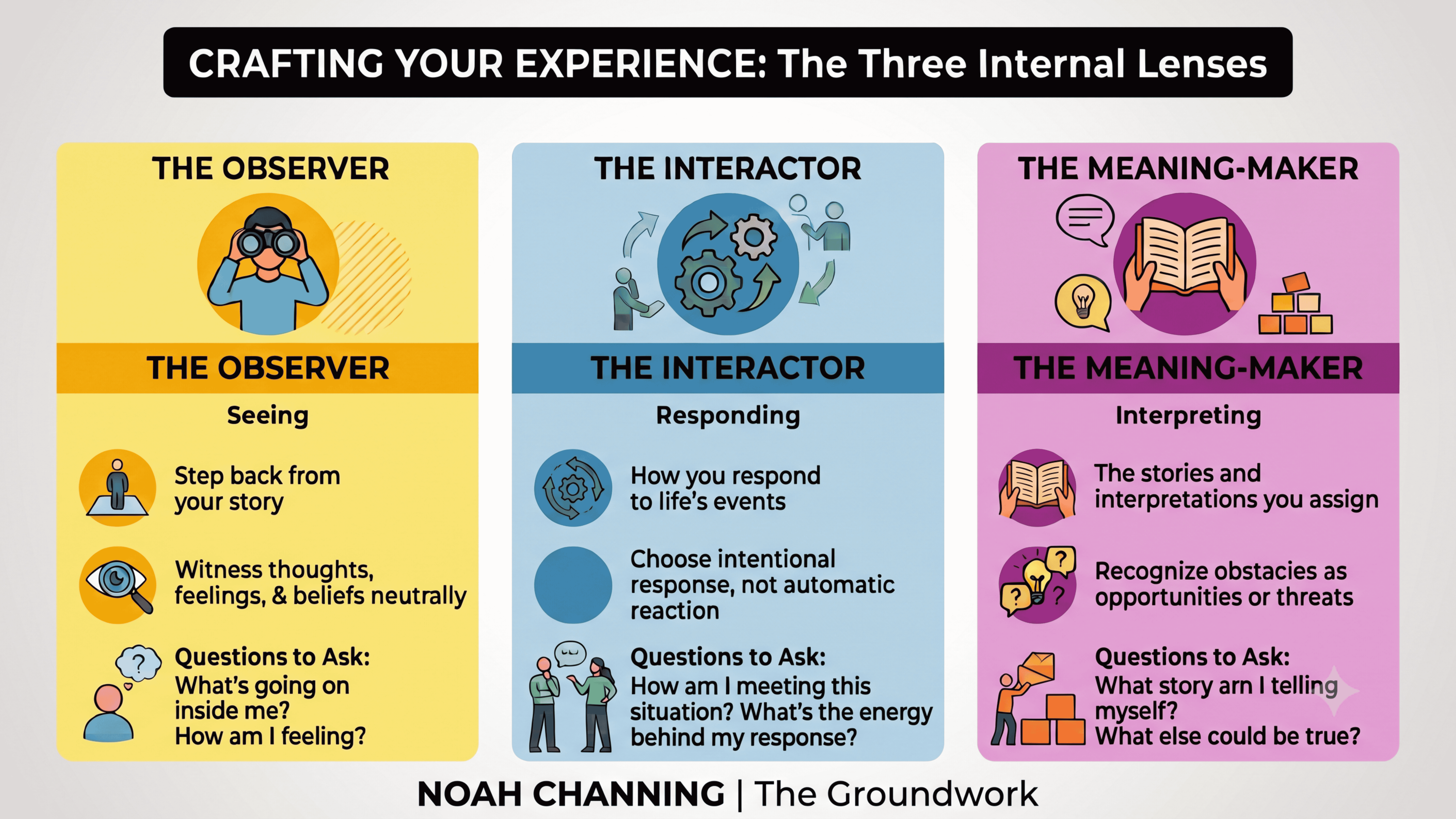
To influence your internal environment, I invite you to look through three mental lenses. You hold all three of these positions. Cultivating awareness of these roles will help you recognize how your internal conditions shape your reality. As the observer, you step back from your story and witness your thoughts, feelings, and beliefs.
-
The Observer
As the observer, your role is to look at yourself and your situation objectively. Using this lens, you step back from your story and witness your thoughts, feelings, and beliefs.
Questions to ask yourself:
-
What’s going on inside me?
-
What thoughts am I thinking?
-
How am I feeling?
-
What is it like to be me right now?
This self-reflective stance allows you to step outside your automatic reactions and recognize your part in shaping your experience. It allows you to step into a neutral space of reflection, where you can see more clearly and identify your role so you can choose your response deliberately.
-
The Interactor
The second lens is looking for your response mechanism - how you are responding to life’s events. Are you responding with patience or impatience? Grace or frustration? Commitment or hesitation? Impulse or Intention? This isn’t about reacting impulsively and finding a story to excuse the impulse. Rather, it’s about responding thoughtfully, based on awareness cultivated through The Observer lens.
Looking deeper into the role you’re playing inside the circumstances.
Questions to ask yourself:
-
How am I meeting this situation?
-
What action am I taking (or not taking)?
-
What’s the energy behind my response?
Paying attention to your responses helps you see where you can introduce more conscious influence.
-
The Meaning Maker
This role involves the stories and interpretations you assign to external events. Do you see obstacles as threats or as opportunities? Are you making assumptions about your worth or future? Recognizing your stories gives you the power to rewrite them.
Questions to consider:
-
What story am I telling about this experience?
-
What am I believing and with what evidence?
-
What else could be true?
Finally, can you settle into the realization that you are the meaning maker; always deciding what the events mean to you.
Understanding that your interpretation profoundly influences your emotional state, which also means it can be changed. Here, you are invited to reframe your role and choose a more empowering narrative.
This internal shift creates a ripple effect, making external hurdles less daunting because you approach them from a resilient, centered state of Awareness.
A Practical Framework to Cultivate Conditions Through Awareness
Having understood the roles and distinctions, here’s a simple, actionable framework to apply:
Step 1: Self-Awareness | Look Inside
-
Pause regularly—especially during stressful moments.
-
Ask, “Am I looking? Am I aware of my own thoughts, feelings, and stories?”
-
Develop the habit of checking in with your internal landscape.
Step 2: Name Your State
-
Be specific: Are you anxious, angry, tired, hopeful, nervous?
-
Instead of trying to control the uncontrollable, focus on your internal state.
-
Remember: small adjustments in your internal conditions have ripple effects on your overall experience.
Step 3: Reframe Your Story
-
Challenge any assumptions or stories that aren’t serving you.
-
Ask: “Is this story true or my interpretation? What else could be true?”
-
Reframe into a more empowering perspective—like seeing setbacks as opportunities to start fresh.
Step 4: Take Ownership
-
Recognize that you are always responding and assigning meaning.
-
Instead of reacting from frustration, let frustration remind you what you really care about.
-
Remember: You can’t control others, but you can control the role you play.
Step 5: Repeat and Reinforce
-
Practice this process often to build the habit of “looking.”
-
Over time, Awareness allows you to move forward with intention, no matter the circumstances.
Use this simple framework to build the habit of turning inward, seeing yourself more clearly, and reorienting to your circumstances, so you can meet this life more intentionally.
Final Thoughts: Your Internal Environment Is Your Greatest Tool
You may not be able to control what happens in the world around you, but you always have the most important say in your life. Practice looking inward, and you'll discover that life becomes less about fighting the uncontrollable variables and more about shaping your internal experience with deep intentionality.
This shift reduces stress and enhances your ability to navigate challenges with clarity and confidence.
If you’re ready to go deeper, consider subscribing to The Groundwork Newsletter. I’ll guide you through building habits that help you transform your life from the inside out.
Come hang out and Let’s Build Together.
- Noah
FAQ’s
Frequently Asked Questions
How do I start developing awareness of my internal conditions?
Go back to the questions outlined above and take the time to answer: “What am I feeling right now?” and “What story am I telling myself?” Be mindful not to discount the effectiveness of small, regular check-ins over time.
Can I really change my internal conditions?
Yes. Conditions are within your influence—they include your beliefs, energy, and responses. With practice, you can intentionally shift them to support your ability to craft more of your own experience.
What's the difference between internal conditions and external circumstances?
Circumstances are outside events or situations such as a setback or conflict. Conditions are your internal responses (your thoughts, feelings, and energy) that color how you perceive and respond to those circumstances.
How does this concept help me deal with stressful situations?
By shifting your focus inward and cultivating awareness, you can respond from a place of clarity and choose with purpose, lessening your reactivity to difficult circumstances. The key is to become conscious of your inner conditions and explore effective ways to engage with whatever life throws at you.
Here's a condensed version of this post on The Groundwork Podcast:
|
Available on all your favorite podcast platforms and YouTube.
Feel free to reach out and let me know what topics you'd like me to cover. :)
Noah Channing - Mindfulness Teacher + Professional Coach
Mindfulness-Based Principles for Powerful Living 👉 Let’s Build Together.
The Groundwork Newsletter + Podcast | www.noahchanning.com
Mental and Emotional Agility -> See Clearly. Live Fully. Build on Purpose.