
The most overlooked and readily available tool for growth is at your doorstep.
Hello there!
In this post, we're diving into the principle "You live where you look" - turning discomfort into growth opportunities. I hope this helps you navigate the tough stuff in a way that moves you toward a deeper sense of resolve.
Let's dive in...
How often do you stop to ask yourself where your attention is really going?
In a world flooded with overstimulation, it is incredibly easy to get caught up in the drift of daily distraction. Without realizing it, we often hand the steering wheel of our lives over to unconscious habits.
What if paying attention to your attention itself is the ultimate key to transforming your life?
Here's what I know: Learning to observe your internal landscape is the first step toward building a richer, more intentional reality.
The Power of Attention: Living Where You Look
Where and How You Focus Shapes Your LIfe
Every day, from the moment you wake up, your attention begins to direct your experience. It shapes how you perceive your environment, your relationships, and your inner world. Whether you enter the day with enthusiasm or dread, your attention influences the direction of your life.
When was the last time you paused to take a look at how you are actively directing your day?
Are you arriving as a passenger, being swept along by old habits? Or are you acting as an architect, deliberately choosing where to place your attention so you can build on purpose?
Our attention functions like a spotlight - what we focus on tends to magnify.
If you dwell on chaos or lack, your world becomes increasingly disorganized or void of something. If you focus on gratitude and presence, you cultivate connection and contentment - both desirable starting points for a life well-lived.
When I work with people on cultivating a more intimate relationship with their attention, I often direct them to one important principle:
You live where you look.
The Invisible Patterns: Paying Attention to Attention
Most of us were never taught the skill of self-observation. When our attention goes unexamined, we unwittingly fall into habitual loops - old thought patterns, negative self-talk, and unaddressed emotions that silently dictate how we show up.
When these habits run on autopilot, they become the silent drivers of our lives, reinforcing limiting beliefs and shaping our future based predominantly on our past. Left unobserved, these patterns continue to go unacknowledged and end up fueling a cycle of distraction and dissatisfaction.
Why does this matter?
The importance of Self-Observation is rooted in seeing yourself clearly and unhooking from the very convincing narratives that keep us stuck in unproductive thought loops. Both limiting beliefs and negative thought loops each survive in environments where self-observance and accountability are low.
They thrive through two things: Unobserved Repetition and Justification.
Directing Your Attention
If you want to create a life of purpose and clarity, start by looking at your attention itself. It’s simple in concept but powerful in practice.
Your attention is a currency. You spend it primarily in one of two ways:
Distraction or Intention.
-
Distraction offers fleeting relief but leaves underlying tension unresolved.
-
Intentional focus builds resilience, clarity, and a sense of purpose.
It’s easy to be distracted in a world that has become centered on social media platforms designed to keep your attention hooked within their platform, rather than focused on your actual life.
Right now, you’re reading or listening to this, and depending on where you’re connecting from - whether it’s my private and direct email newsletter, on Substack, or Medium - you are choosing where and how to place your attention.
The choices you make on a moment-to-moment basis include what you focus on and what you ignore.
These choices set the stage for your reality. Choosing how you will spend your attention currency.
Pause for a moment and reflect:
-
Where does your attention habitually go? Is it drifting or assigned with intention?
-
What do you actively ignore?
Often, what we ignore is just as significant as what we attend to. Habitual blind spots tend to mask recurring patterns.
Sometimes, it’s that very moment we use to pause and look more closely at our attention that becomes the time well spent. So, if you didn’t bother to answer those previous questions, now would be a good time to go back and do so.
If it feels uncomfortable for you to not read ahead, to not continue down the path your habitual mind wants to take you - let that discomfort tell you something valuable. Remember, we are conditioned to keep reading forward. It requires the deliberate use of your attention to go back and answer those questions before moving ahead.
The habitual mind is incredibly persuasive, and that was a small exercise in identifying when the habitual mind is taking over. Whether it worked or didn’t isn’t the point.
The point is to look at your attention itself.
The Art of Working With Discomfort: As an Invitation, Not an Enemy
When I talk about discomfort with the people I work with, one interesting trend that shows up is that most people don’t immediately refer to their experience as discomfort. They call it by many other names (all of which are accurate), but they rarely say the word “Discomfort.”
For example, it is very common for people to come forward with the following phrases to describe the things that they want to work on:
Navigating Uncertainty
Building Confidence
Developing Patience
Conflict Management
Communicating More Effectively
Being Present
And so on…
They are all areas I work on daily.
If you look closely at them, the underlying root cause is the same: Discomfort.
Discomfort is one of our most overlooked tools for personal growth.
Consider it an internal compass pointing you toward mental or emotional blockages that may be lurking subconsciously and negatively affecting you.
I call these subconscious blockages: Unresolved Knots
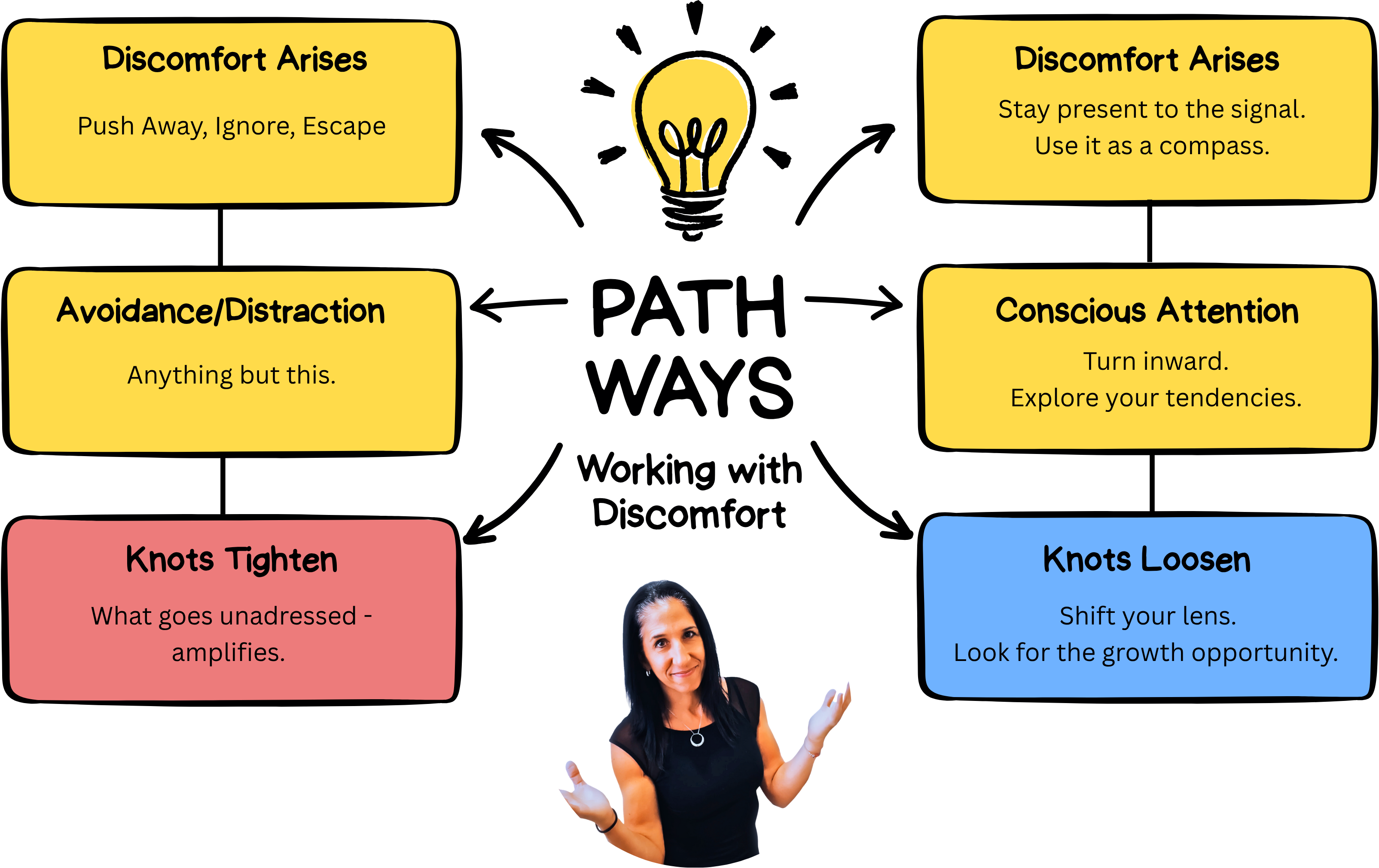
The more we run from these knots, the tighter they pull. They even pile up on top of one another, underneath the surface of our everyday lives, making it increasingly difficult to feel good about things as they currently are.
Conversely, when we bring a gentle, curious attention to our discomfort, the knots begin to loosen.
Like everything in life, these internal knots are not permanent. We can learn to work with them. Untangle them. Become acquainted with what they were trying to hold together in the first place.
If done often enough, with some guidance, this can become part of a practice that enables growth, progress, and clarity.
Exploring Discomfort as an Invitation
When heaviness or tightness arises, your instinct might be to soothe yourself. Oftentimes, we turn to distraction. You might reach for your phone, turn on the TV, or seek quick and instant relief in some other way.
But what if those sensations are actually invitations to take a deeper look inside and explore what they are trying to tell you?
Rather than turning away from discomfort, consider it an internal compass pointing you toward the unresolved knots you may be carrying. Instead of giving in to the urge to flee, simply stay there long enough to bring your attention to your attention itself.
Then ask yourself:
- What is my attention moving toward?
- What am I avoiding?
- Is discomfort guiding my focus?
See if you can treat your discomfort as an invitation, rather than an alarm bell. Notice how you interact with discomfort itself.
Discomfort is not the enemy.
It’s a call to resolve.
Yes, it may be asking you to change something externally. And you may very well want to do that. However, check in with yourself first before you kick the can down the road and inevitably come face to face with what’s truly trying to be resolved within you.
When you learn to get really curious about your relationship with discomfort, you start making decisions from awareness rather than from habitual thoughts and patterns that have been kicking the can down the road.
There is a path to inner peace and resolution.
Rather than avoiding discomfort, here are a few helpful things to try:
-
Notice where your eyes and thoughts go as discomfort arises. Remember, you’re looking for your attention itself.
-
Bring attention to what you’re tempted to escape from.
-
Resist the urge to flee, and instead, explore the discomfort gently before you proceed.
This process helps build the capacity for resolve. It helps strengthen your ability to stay present and engaged with difficult emotions. Over time, your internal knots begin to loosen, and your resilience becomes growth.
The more you resist the discomfort, the tighter the knots become. The more you build the capacity to engage with difficulty, the looser the knots become.
It’s not about fixing everything at once; it’s about engaging with discomfort courageously and patiently so that your internal state begins to feel safe and capable again - positively affecting the way you interact with challenges and obstacles.
Recognizing the Ego's Narrative
We all have one fundamental obstacle: the ego. It constantly constructs stories about who we are and seeks to keep us at the center of our narrative.
The ego loves to resist discomfort and change. In fairness, it’s trying to keep you safe. The part that becomes problematic is when that familiar and convincing voice inside our heads sounds the alarm bell when there is no actual danger - or worse, when growth is at your doorstep.
I talked about this on my podcast recently (The Groundwork Podcast).
“The ego always tries to keep you as the star of the show.” Even if it means living in a storied illusion.
But the thing about reality is that there are all these stories and perceptions intersecting all the time.
No one is actually the star of the show. And everybody is simply living where they look.
Recognizing this helps you detach from the false narratives and see reality more clearly, while the ego goes on constructing its version of things. We all have this part of us. It has a job to do.
However, that doesn’t always make it accurate or effective. So the more we get to know it (and the rest of ourselves), the better we can discern between what our discomfort is really trying to tell us versus when it may be leading us astray.
When you build the capacity to observe your thoughts and feelings without so much personal attachment, you begin to differentiate which part of yourself is trying to run the show. This is when you can approach discomfort as an opportunity rather than an adversarial experience.
In this way, Awareness and Attention work more effectively together.
The Role of Conscious Attention in Shaping Your Reality
Discomfort is the compass inviting you to pay attention to your attention itself.
This means choosing what to look at, what to focus on, what to notice, and how to effectively engage with the uncomfortable things as a means to more authentic living.
If you avoid facing your inner world, you reinforce recurring patterns and trap yourself inside small loops of familiar distress.
Remember, you live where you look.
Look for growth, and you’ll find it.
Look for an escape, and you’ll find that too.
Escape will convince you to always be somewhere else, and you will spend your life trying to live where you aren’t.
Look beyond the surface. Examine your lens:
-
How are you showing up to your life?
-
Are your distractions interrupting your true priorities?
-
What internal knots need your attention?
By shifting your focus inward, you gain clarity on how to navigate and subsequently curate your outer world more effectively.
That is my wish for you. To live openly, honestly, and completely fulfilled.
- Noah
Below you will find the Newsletter+ extended version that includes:
- Practical Steps
- FAQ’s
- Additional Links
Practical Steps
Some Practical Steps to Work With Attention
Changing your relationship with your mind requires deliberate, daily practice. Use these five strategies to begin moving from autopilot to active attention:
- Observe the Quality of Your Attention: Set a few alarms on your phone. When they go off, take note of habitual distractions and check in: Are you scrolling, ruminating, or seeking external validation? Where is my attention right now? Am I fully present to what’s in front of me? Look for attempts at avoidance.
- Explore Your Tendencies: The next time you feel discomfort or when uncomfortable feelings emerge, pause at the exact moment you notice. Breathe into the physical sensation and ask: Am I trying to escape this? What am I trying not to feel? Name it. Get acquainted with what discomfort is really trying to tell you.
- Turn Toward Discomfort: Notice your internal experience and investigate the discomfort itself. Notice the urge to flee or change something external. Ask yourself: How am I showing up to this situation? Is my current perspective serving me? What role am I playing in this tension?
- Embrace the Knots: Meet your internal tension with curiosity. Let go of any judgment that arises. Your internal knots do not untie themselves. They untangle when they are witnessed, acknowledged, met with care, and stayed with long enough for the surface tension to settle. From there, we can get to a place of resolve.
- Choose Alignment when Decision-Making: Treat your attention as your most valuable currency. Spend it wisely on thoughts, intentions, and actions that build resilience rather than short-term escape.
If you narrow this down to two things, it’s this: Harness Attention and Engage Discomfort. The main points to remember as you start putting this work into practice are:
Use Discomfort as a Signal for Growth
- Treat discomfort as an internal signal that something within you wants to be resolved.
- Meet it with real curiosity instead of allowing avoidance to become a missed opportunity for growth.
- Use discomfort as a compass, pointing you toward the part of you that really needs your attention.
Cultivate Resolve over Avoidance
- Understand that mental and emotional agility comes through Awareness, Intention, Resolve, and Re-Engagement.
- Engage with your inner landscape - tend to your unresolved tension with purpose versus pressure.
- With practice, this helps build inner strength and a more authentic life.
- Notice your patterns.
- Work with discomfort.
- Shift your lens.
Before rushing to change your external circumstances, look for how you see yourself inside them. This doesn’t mean change nothing. Rather, before you change anything external, reflect on what within you needs your attention. Then proceed.
Ask yourself:
How am I showing up to this?
What story am I stuck on?
Drop the narrative. Notice what feels uncomfortable about letting it go.
That is your knot. Work with it.
A VISUAL REFERENCE:
FAQ’s
Frequently Asked Questions
How can I start paying more attention to my attention?
Start by practicing daily self-reflection. Be specific with it. Set aside time throughout your day to “pause on purpose” and actively look at where your attention is going. This helps you build awareness. You can also try mindful breathing: take a deep breath, focus on the in-breath, pause, then follow your attention as you breathe out. Pause again, and bring your focus back to your next in-breath.
Why does personal growth require us to face discomfort?
Discomfort shows us where we tend to hold back, hesitate, or withhold. When we face discomfort, we can work through these limits, break old habits, and become more emotionally flexible.
What is the difference between indifference and resolve?
Indifference is an attempt to detach from care or pull away emotionally. Resolve is about paying attention and caring enough to face discomfort. When you allow yourself to feel discomfort and work through it, it loses its hold on you.
What if I have trouble changing my mental habits?
Changing your mental habits takes time, so be patient with yourself. Small, steady changes in your daily awareness add up. If you have setbacks, see them as part of learning to handle discomfort differently. Habits stick around when we don’t question them. Try listing what triggers your resistance, then pick one habit to focus on. If you try to change too much at once, it can feel overwhelming. Start small and focus on one thing at a time.
Why is it so hard to face discomfort?
When you feel discomfort, your brain quickly activates its survival instincts of fight, flight, or freeze. In situations that aren’t truly dangerous, you can learn to be curious about discomfort and see it as a chance to grow instead of something to avoid.
How does focusing on my internal knots help with external challenges?
When you give yourself time to work through inner tension, you become better at handling change and challenges with clarity and confidence. Over time, you’ll respond to outside problems more calmly and thoughtfully, instead of reacting out of habit. For example, if stress makes your heart race, you can’t just force it to slow down. Instead, notice what thoughts and feelings come up, so you can work on the part of your experience you can actually change.
How does shifting my perspective help me change my life?
When you shift your perspective, you can see what’s really going on beneath the surface. This helps you understand your deeper patterns and change how you experience things, so you can act with more clarity, purpose, and calm.
Here's a condensed version of this post on The Groundwork Podcast:
|
Available on all your favorite podcast platforms and YouTube.
Feel free to reach out and let me know what topics you'd like me to cover. :)
Noah Channing - Mindfulness Teacher + Professional Coach
Mindfulness-Based Principles for Powerful Living 👉 Let’s Build Together.
The Groundwork Newsletter + Podcast | www.noahchanning.com
Mental and Emotional Agility -> See Clearly. Live Fully. Build on Purpose.